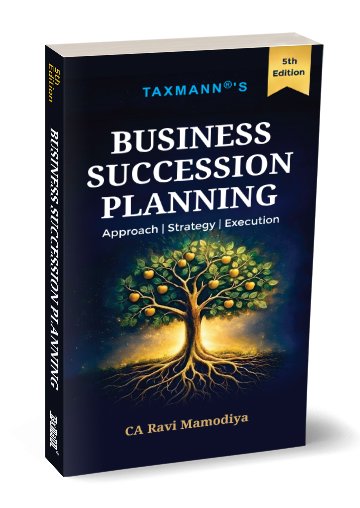
Business Succession Planning Ravi Mamodiya Edition April 2026 Business Succession Planning Ravi Mamodiya Edition April 2026 Description The Present Publication is the 5th Edition, authored by CA. Ravi Mamodiya, with the following noteworthy features: [Three Proprietary Frameworks] The book is anchored in three original frameworks developed through direct advisory practice The 5-Step Succession Approach (Owner’s Vision → Family Constitution → Business & Family Alignment → Successor Identification and Grooming → Ownership Transfer and Estate Planning) The AMG Model (Assessment → Management → Grooming) for successor development 3-P Framework (People, Property, Proportion) for Will drafting [The Wheel of Succession] A self-diagnostic tool that maps readiness across all five succession dimensions on a 0–100% scale. The owner rates each dimension, plots the polygon, and identifies gaps. Separate wheel templates are provided for family, business, and professional succession [Three Differentiated Succession Frameworks] Rather than a single generic model, the book provides distinct frameworks for family businesses (5 steps), non-family business succession (3 steps), and professional/service firms (5 steps with partner alignment and practice-specific considerations) [India-Specific Legal Architecture] Every legal dimension is grounded in Indian statute: SEBI LODR Regulation 17(4) and Companies Act 2013 Section 178 for listed entities; Hindu Succession Act 1956 (with 2005 Amendment); Muslim Personal Law (Shariat); Indian Succession Act 1925 for Parsis and Christians; Indian Trusts Act 1882; HUF law; income tax treatment of inheritance and capital gains; and succession certificate and probate procedures [The Garud View vs. Sarp View] A conceptual framework drawn from Hindu mythology—the Garud (eagle’s strategic perspective) vs. the Sarp (snake’s operational ground view)—used throughout the book to explain why succession planning is perpetually deferred by even sophisticated owners, and why cultivating a long-horizon perspective is the foundational precondition for any succession process [Owner’s Vision—Internal and External] Vision is decomposed into two dimensions: the internal dimension (vision, mission, goals, purpose, passion, and GPS business plan framework) and the external dimension (output metrics, internal systems, resource quality, stakeholder assessments, and competitive positioning), including an organisational chart exercise that maps each role’s vulnerability if its current incumbent were absent [Family Constitution—Full Governance Architecture] Treated as a governance institution, not merely a document. Covers six constitutional bodies (Family Council, Family Assembly, Family Association, Owner’s Council, Family Fund, Family Office); a five-step constitution-building process; the dangers of miscommunication (illustrated through Ranbaxy, Raymond, and Ponty Chadha); and two dedicated chapters on balancing individual aspirations with family unity and on the constitution as a living guide. A complete draft Family Constitution is included as Annexure 4 [Two and Three Circle Model] Maps seven stakeholder positions across family, business, and ownership circles, demonstrating that different decisions require different decision-making bodies—applied through the Karthik-Suresh family business case study [Quantified Successor Evaluation Tools] The AMG model is operationalised through a 20-dimension leadership assessment scoresheet (five domains, five-point scale, four leadership bands) and the 9-Box Succession Planning Grid Matrix mapping potential against performance across nine candidate profiles [Multi-Dimension Grooming Framework] Successor development is mapped across five formal practices—Education, Assessment (360-degree feedback), Coaching (ICE Model), Mentoring, and Experiential Learning—with an initiative-to-practice mapping table and a five-step selection sequence (Forecast Analysis → Resource Development → Selection → Trial Run → Transition) [Exit Strategies and Liquidity Management] A material 5th Edition addition covering: insurance instruments as liquidity tools (key person, buy-sell, deferred compensation, disability, collateral), IPO as an exit mechanism, and the Family Office (SFO vs. MFO structure, functions, and governance)—each illustrated through embedded case studies [Historical and Macro Context] A five-stage historical taxonomy of Indian family business evolution from pre-1750 to the present, framing the current moment as an unprecedented economy-wide generational transition—contextualised against NITI Aayog’s Vision India @ 2047 target of USD 30 trillion GDP [Gender and Generational Dimensions] Dedicated coverage of gender bias in succession and the female entrepreneur’s unique succession journey; and a generational taxonomy mapping Founders, Gen X, Millennials, and Gen Z as successive cohorts with distinct mindsets and transition challenges [Four Deployment-Ready Legal Templates] Annexures include complete draft formats for a Private Trust Deed, HUF Creation Deed, Will, and Family Constitution—usable as working references by practitioners and business owners [Structured Checklists at Every Stage] Every part closes with Yes/Partially/No checklists covering business dynamics readiness, parallel planning, transition management, family succession selection, and business succession evaluation—with interpretive guidance for each response type [16 Myths Systematically Debunked] Chapter 3 dismantles 16 of the most common Indian misconceptions about succession planning—from ‘it’s only for the ultra-rich’ and ‘equal distribution is always fair’ to ‘nominees inherit assets’ and ‘succession is inherently a male heir’s right’ About the author Ravi Mamodiya is a renowned Chartered Accountant, entrepreneur, and business consultant known for his unconventional approach to business and organizational processes. A 2011 fellow of the Institute of Chartered Accountants of India, he earned his postgraduate degree from Rajasthan University. Ravi is the Managing Partner at M/s AR Mamodiya & Co., Chartered Accountants, based in Jaipur. Ravi’s career includes significant roles at Hindustan Zinc and Ernst & Young and extensive work with SMEs, where he specialized in turning around businesses through practical, ground-level solutions. His distinctive career path reflects his capacity to rethink and reshape business continuity planning, earning him a reputation for straightforward communication, logical reasoning, and innovative organizational design.
Related products

$ 6.60
$ 21.07
$ 11.17