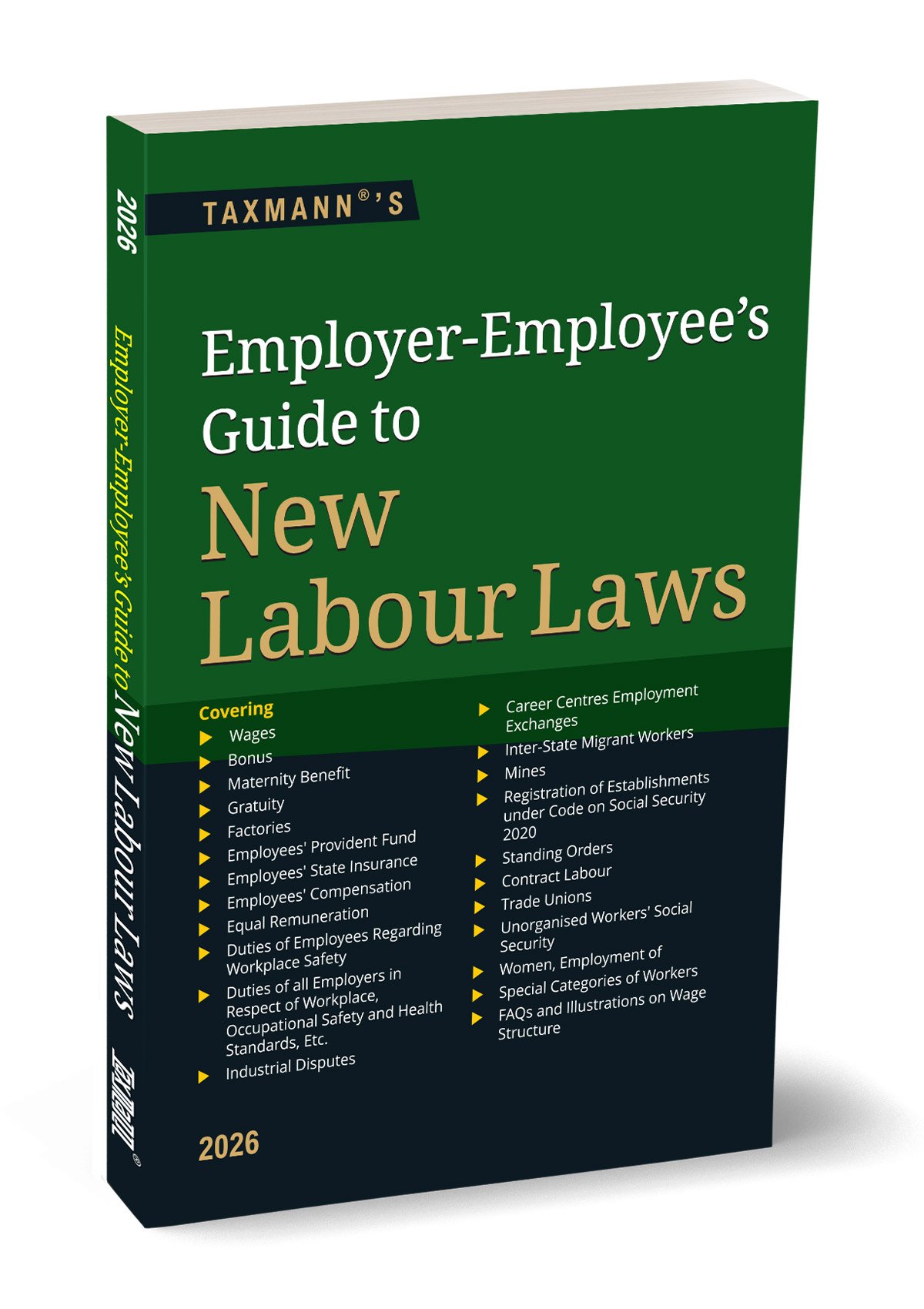

Employer-Employee’s Guide to New Labour Laws 1st Edition June 2026 Employer-Employee’s Guide to New Labour Laws 1st Edition June 2026 Description Employer-Employee’s Guide to New Labour Laws is a focused, practical handbook that explains how India’s labour-law landscape has been transformed by the four new Labour Codes and what that transformation means, in concrete terms, for employers and employees alike. The four Codes are: The Code on Wages 2019 (COW 2019) The Industrial Relations Code 2020 (IRC 2020) The Code on Social Security 2020 (CSS 2020) The Occupational Safety, Health and Working Conditions Code 2020 (OSHWC Code 2020) These four Codes consolidate and replace more than two dozen erstwhile central labour enactments—among them the Payment of Bonus Act 1965, Payment of Gratuity Act 1972, Minimum Wages Act 1948, Payment of Wages Act 1936, EPF Act 1952, ESI Act 1948, Employees’ Compensation Act 1923, Factories Act 1948, Industrial Disputes Act 1947, Contract Labour Act 1970, Trade Unions Act 1926, Maternity Benefit Act 1961, Equal Remuneration Act 1976, Inter-State Migrant Workmen Act 1979, and the Unorganised Workers’ Social Security Act 2008. The book is built around the fact that all four Codes came into force on 21st November 2025, making this 2026 edition a timely, transition-stage guide, with the law set out up to 15th June 2026. Crucially, the book does not simply reprint the statute. Its organising principle is a single, high-value question—’what has actually changed?’ Topic by topic, it isolates each new definition, revised threshold, fresh compliance obligation, and altered entitlement under the Codes, and contrasts it with the corresponding provision in the repealed Act (often citing both the old section and the new Code section). The result is a change-oriented digest that lets either side of the workplace relationship understand the practical impact of the new regime quickly and precisely. The guide is pitched at both a general and a professional readership: Employers, Business Owners, and Management who must understand and discharge new compliance duties (registrations, notices, licences, wage restructuring, returns) under the Codes HR, Personnel, Payroll, and Compliance Teams re-engineering salary structures and benefit calculations to align with the new, unified definition of ‘wages’ Employees, Workers, and their Representatives/Trade Unions who want clarity on revised rights, eligibility, and protections Practitioners—Labour-Law Advocates, Company Secretaries, Chartered Accountants, and Consultants—needing a fast, reliable change-reference Students and Academics in Law, HR, and Management seeking a clear orientation to the new four-Code architecture It’s plain-language, comparison-driven style serves newcomers as an explainer and experienced professionals as a desk-side ready reckoner The Present Publication is the 1st Edition, updated till 15th June 2026, authored by Taxmann’s Editorial Board with the following noteworthy features: [Change-Focused, not Text-Heavy] Every chapter pinpoints what is new or different under the Codes and sets it against the repealed Act, so the practical effect is immediately visible [All Four Labour Codes in One Slim Volume] Wages, Industrial Relations, Social Security, and OSHWC are covered together, with cross-references between old and new provisions [Built Around the Unified ‘Wages‘ Definition] The single definition of ‘wages’ [Section 2(y), COW 2019] now applies across all four Codes—and the book devotes a full chapter to it [Worked Illustrations of the ‘50% Rule‘] Concrete, rupee-by-rupee examples show how allowances exceeding 50% of total remuneration are added back to ‘wages,’ and how this re-bases bonus, gratuity, PF, and ESI [Latest Government Clarifications] Reflects the official FAQs on Labour Codes dated 30-12-2025 and the Additional FAQs dated 16-03-2026 [Dual Employer–Employee Lens] Obligations and entitlements are presented from both sides of the workplace relationship [Topic-wise Alphabetical Arrangement] Subjects from Bonus to Special Categories of Workers are easy to look up [Granular Paragraph Design] Each topic is split into numbered points, each flagging one discrete change [Built-in Reference Aids] A list of abbreviations maps each repealed Act to its short form, and a subject index supports quick navigation The guide spans 23 chapters across wages, social security, workplace safety, and industrial relations. Thematically: Wages & Monetary Benefits Wages — The new unified definition and its downstream effects Bonus — Uniform accounting year (1 Apr–31 Mar) for all employer-entities; revised eligibility/threshold limits; impact of the new “wages” definition on bonus payable Gratuity — Including recognition of fixed-term employees, who become eligible for pro-rata gratuity even where service ends without completing the usual 5 years of continuous service Equal Remuneration FAQs and Illustrations on Wage Structure Social Security & Welfare Employees’ Provident Fund (EPF) Employees’ State Insurance (ESI) Employees’ Compensation Maternity Benefit Unorganised Workers’ Social Security — Now expressly extended to gig workers and platform workers, with new registration and welfare provisions Registration of Establishments under the Code on Social Security 2020 Occupational Safety, Health & Working Conditions Duties of Employees Regarding Workplace Safety Duties of All Employers in Respect of Workplace, Occupational Safety and Health Standards, etc. Factories Mines Industrial Relations & Employment Administration Industrial Disputes — Including the new framework for fixed-term employment Standing Orders Trade Unions Contract Labour — Applicability threshold raised from 20 to 50 workers; new electronic licensing, work-specific licences, and notice requirements Career Centres/Employment Exchanges — ‘Employment Exchanges’ reconceived as wider ‘Career Centres,’ which may be portals and also serve self-employment Special Categories & Protections Inter-State Migrant Workers Women, Employment of — Including provisions permitting women to work at night (beyond 7 p.m. and before 6 a.m.), subject to prescribed safety conditions and the woman’s consent Special Categories of Workers Across these topics the book consistently highlights the concrete shifts—new definitions, raised or removed thresholds, electronic notices and registrations, and reworked entitlements—rather than leaving the reader to infer them from the bare Code text Spotlight — The Unified ‘Wages‘ Definition & the 50% Rule The book’s standout practical contribution is Chapter 23 (FAQs and Illustrations on Wage Structure), which addresses the change with the widest payroll impact: a single statutory definition of ‘wages’ now governs bonuses, gratuities, employer PF contributions, and employer ESI contributions across all four Codes In essence, ‘wages’ = Basic pay, Dearness Allowance & Retaining Allowance, with specified components excluded. But under the 50% rule, if total excluded allowances exceed 50% of total remuneration, the excess is added back into ‘wages.’ The chapter works this through in plain figures, for example: On a CTC of ₹1,00,000/month (Basic & DA ₹20,000; allowances ₹60,000; gratuity ₹20,000), 50% of ₹1,00,000 is ₹50,000. The allowance excess over that cap is ₹10,000, which is added back—so statutory ‘wages’ become ₹30,000, and bonus/gratuity/PF/ESI are computed on that figure It also reproduces and explains the Government’s own illustration from the FAQs on Labour Codes dated 30-12-2025, making the chapter a hands-on tool for HR and payroll teams restructuring compensation The structure of the book is as follows: Front Matter — Chapter-heads, a detailed analytical table of contents (down to sub-paragraph level), and a list of abbreviations that maps each of the two-dozen-plus repealed Acts to its short form 23 Topic Chapters Arranged Alphabetically — From Bonus (Chapter 1) through Special Categories of Workers (Chapter 22), so any subject can be found without an index search Comparative, Numbered-paragraph Design — Each chapter opens by naming the repealed Act and the Code (and chapter) that now governs the subject, then proceeds point-by-point (1.1, 1.2 …), each point isolating a single change and frequently citing both the old section and the new Code section A Dedicated Practical Chapter — Chapter 23 (the final chapter) converts the new wage definition into Q&A plus worked numerical illustrations Closing Reference — A Subject Index for pinpoint navigation This lets a reader either read a topic end-to-end or jump straight to one specific change—equally suited to study and on-the-desk compliance checks. About the Author Taxmann’s Research & Editorial Board includes Chartered Accountants, Company Secretaries, and Lawyers working under the editorial direction of Editor-In-Chief Mr Rakesh Bhargava. The team operates at the junction of legal expertise and editorial rigour, producing content that meets the high standards of India’s professional knowledge community.
Related products
$ 11.17